
Senescence: A Key To Immortality?
Senescence is defined by the online dictionary as "the organic process of growing older and showing the effects of increasing age". Cellular Senescence is the phenomenon where diploid cells simply cease to divide, which is usually after 50 cell cycles or so. Cells can be induced to Senescence by certain toxins, irradiation and oncogenes. In response to the shortened telospheres in a cell, it is programmed to remove itself via cell apoptosis for the good of the organism as a whole. These inactive cells usually adopt a flattened cell morphology and sit dormant, having had other apsects of their phenotype altered too, remaining metabolically active and also becoming more resistant to age related diseases in the process. 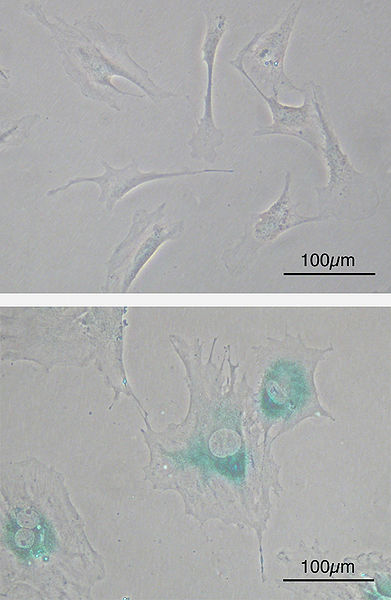
For example, in a study conducted in 2011, mouse cells were deliberately eradicated and it was shown they were far more resilient to age-associated diseases. The top slide shows mouse embryonic fibroblast cells. The bottom slide shows the same cells after they had been eradicated and dyed using a marker called SABG which is appearing blue, indicating the expression of senescence-associated β Galactosidase. These cells are generally associated with production of age related phenotypes and it has been shown that their removal can prevent certain tissue dysfunctions.
We expect that cell senescence occurs in an attempt to prevent or lower the risk of cancer but it is not known how exactly it occurs. One interesting fact though is that Supercentenarians are often shown to have uniformly ageing cells. This would make sense as the body behaves on a "weakest link" system where if one system or component fails, it may lead to a total failure and death.
There are also certain Molluscs and members of the Hydra genus do not illustrate cell senescence and could be deemed biologically immortal. Upon mitosis their chromosomes illustrate no loss of the telosphere which is what may cause cell senescence.
I think it would be incredible if a treatment was developed that could remove these senescent cells. Given that I have only briefly researched this topic for you, I am not sure of the implications healthwise after their removal but from what I have gathered the pro`s outweigh the con`s. Perhaps epigenetics could be a way forward in this field?